

 Hebba Gouda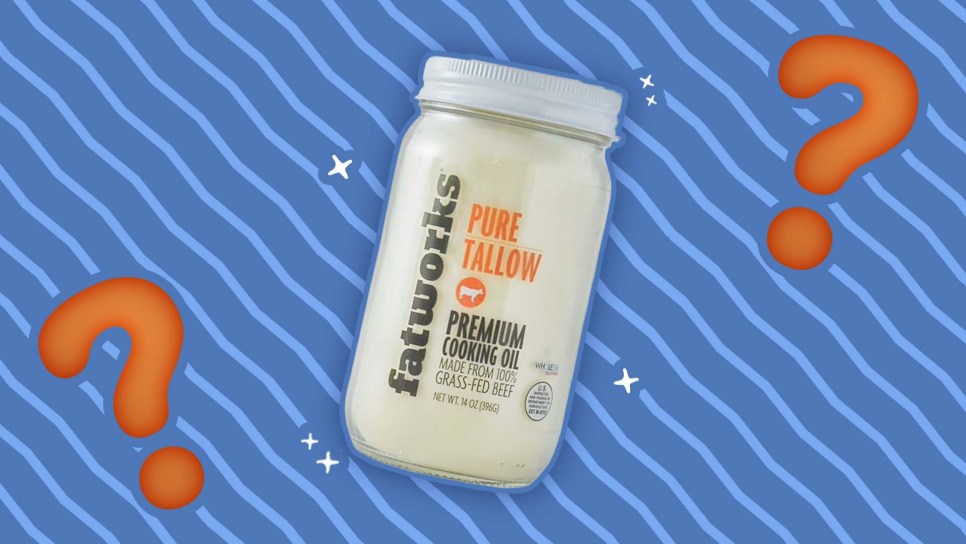
Whether you’ve been leafing through Grammy’s recipe cards, scrolling social media, or following U.S. politics, you may have seen beef tallow come up. Much like bell-bottom jeans and chunky sneakers, beef tallow was big with the older generation, seemed to disappear for a while, and is now making a comeback.
Videos by Sporked
But what is beef tallow, exactly? How can something be a crucial secret to not only the family pastry recipe, but glowing, ageless skin? Is it worth the hype, or is that all it is—hype?
If you’ve ever found yourself in the sweet spot of being curious about beef tallow but too lazy to do the research, you’re welcome! We’ve done it for you!
What is beef tallow?
Beef tallow is a white-ish substance (get your mind out of the gutter), made by removing, simmering, and clarifying fatty tissue around a cow’s organs. It’s a bit of a sister substance to lard, it’s solid at room temperature but liquid when heated. However, lard is specifically from pigs, and has a softer texture, and milder flavor.
How is it used?
Beef tallow has a high smoke point, so it’s often used for cooking at high temperatures (like deep frying and roasting). Where olive oil will send your smoke alarms into a frenzy, tallow and its 400 degree F smoke point will still be cool, calm, and collected. Well, not literally cool. It’ll be 400 degrees. But it won’t make your fried food taste like you seasoned it by scrubbing the grill grates directly over it.
Using it in baking can result in flaky pastries and tender cakes but tallow’s rich, meaty flavor can be a double-edged sword. It’s probably a little better in a pot pie recipe than a key lime pie recipe.
Outside of the kitchen, tallow is also used in candle-making, soaps, and topical skincare.
What are the benefits of beef tallow?
Beef tallow is trending hard right now, probably at least in part because of its unique fat profile. It’s similar to our skin’s natural oil, so the idea is that it can be used as a moisturizer.
It has supposed anti-inflammatory benefits that are said to help improve skin’s elasticity and overall healthy appearance when applied topically. Plus, you’ll save money on aftershave, if your regular aftershave is slapping a Big Mac patty on your cheeks.
Nutritionally speaking, saturated fats have gotten a bad rap. But, like many demonized things, they can have benefits when consumed or used in moderation. Tallow contains nutrients like vitamins A, D, E and K, and an omega-6 fatty acid called conjugated linoleic acid (CLA) that may have anti-inflammatory and antioxidative properties.
What are the problems with beef tallow?
The trendiness of beef tallow is a blessing and a curse. It’s getting a lot of attention, but a lot of influencers are swearing by the stuff, preaching its benefits as gospel without concrete information. We’d love to believe that slathering this on our necks will have us aging as gracefully as Jennifer Aniston and a spoonful per day will fix our guts, and there’s anecdotal evidence about the health perks, but further research is needed.
Additionally, it is still dense with saturated fat the consumption of which in high qualities is linked to poor heart health.
When it comes to skincare, it’s important to note that tallow is occlusive, meaning it prevents water from escaping. So, moisturizing with it is a little like putting a film over your skin, so it is not exactly ideal for those with oily or acne-prone skin.
It is also a beef product, so it’s not exempt from cow’s negative environmental effects.
Are you on the beef tallow train? Let us know in the comments.
 Justine Sterling

Thoughts? Questions? Complete disagreement? Leave a comment!