

 Jay Wilson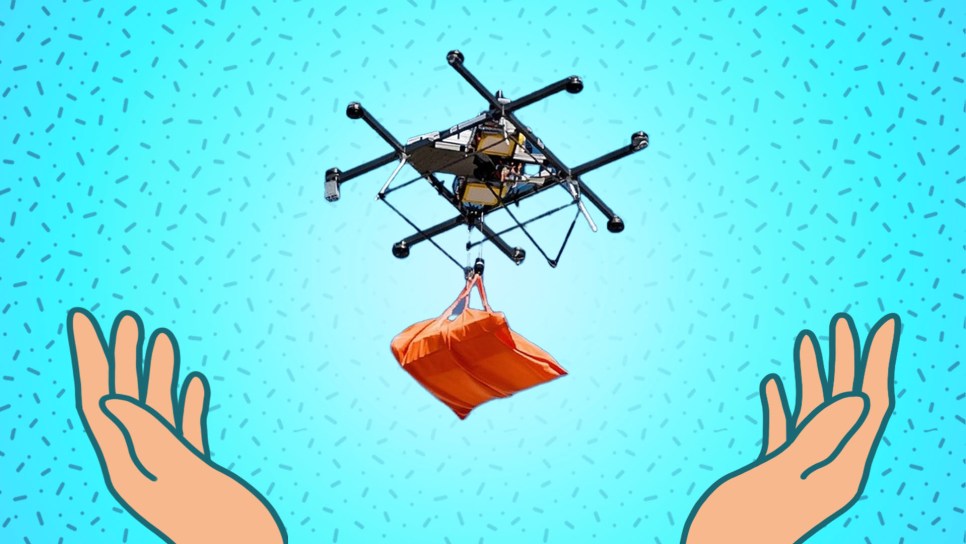
The discussion around food drone delivery has been going on for a good couple of years now – and while tech companies and food industry experts alike have been saying that receiving your pizza or burgers via a flying machine in the sky will one day be standard for ages, it currently…isn’t. 2026, though, has reignited the chatter around drone delivery. A few months ago, Little Caesars partnered with Flytrex Drone Delivery to start sending out drone-delivered pizzas, and it seemed like a big step towards a wider rollout for everyone else.
Videos by Sporked
So, why hasn’t it actually happened yet? What’s the hold-up? Beyond the clearly worrying moral question of whether we should be automating even more processes that humans are employed to do, what are the logistical boundaries at play? Let’s look at a couple.
Crowded Airspaces
One of the biggest hindrances to wide-scale food drone deliveries is the issues they pose to airspace safety and, therefore, public safety. The US Government Accountability Office recently published a blog post discussing how the Federal Aviation Administration (or FAA) is handling drone traffic management and the problems posed by the fact that drones don’t have two-way communication systems with aircraft.
Drones generally fly at low levels, but the more crowded the skies get, the more risks they may present. A lack of technological ability to accurately track the location information of all objects in the sky is another issue. Until these problems are adequately tackled and addressed, there may still be a hold-off on wider adoption of food drone deliveries.
Cost
While drone deliveries feel like a cost-saving move for restaurants and food delivery services (and, indeed, one day they may be just that), at the moment, they’re pretty expensive – and this is limiting their expansion. Restaurants that have run trials of drone deliveries have been limited by the sheer price of it all, says Aaron Zhang, founder and CEO of A2Z Drone Delivery, Inc, in an interview with PMQ Pizza. “The most limiting structural constraint is that these trials remain siloed to a single restaurant brand, leaving that one brand to shoulder the financial investment to set up the operation, staff it with pilots and operators, and manage the infrastructure.”
So, until drone delivery companies and infrastructure grow enough to allow restaurant brands to adopt the method without significant outlay, it probably won’t happen. At the moment, though, regulators are still catching up.
Manpower
Yes, drones may eventually be automated – but at the moment, they’re not. Restaurants and food companies have to divert significant resources to the management of drone deliveries, and that can mean employing further people to monitor them. “Most of the current trial operations are still reliant on a great deal of individual manpower to safely conduct their deliveries,” says Zhang. “In the U.S., most are required to maintain visual-line-of-sight with the commercial delivery drone, making a string of forward observers a costly investment to reach farther from the delivery hub.”
So, essentially, everything’s tied together in a lack of proper, systematized incorporation of this technology on a higher level, and no companies yet offer widespread, affordable solutions. Until that all shifts, the old-fashioned method will continue to reign. And maybe that’s a good thing.

 Griffin Parker
 Gwynedd Stuart
 Justine Sterling
Thoughts? Questions? Complete disagreement? Leave a comment!